| Sign In | Join Free | My qualitytoyschina.com |
|
| Sign In | Join Free | My qualitytoyschina.com |
|
| Categories | Heat Exchanger |
|---|---|
| Brand Name: | Botai |
| Model Number: | TL15B-H |
| Place of Origin: | China |
| MOQ: | 1 |
| Price: | Negotiable |
| Payment Terms: | L/C,D/A,D/P,T/T,Western Union |
| Supply Ability: | 100 |
| Delivery Time: | 10 Working Days |
| Packaging Details: | Wooden box |
| Origio: | Tian Jin, China |
| Productioncapacity: | 100000pieces/Year |
| Design Pressure: | 2.2m/PA |
| Material Type: | SS304/SS316L |
| Company Info. |
| Tianjin Shiny-Metals Technology Co., Ltd. |
| Verified Supplier |
| View Contact Details |
| Product List |

| Component Name | Structural Design | Core Functions and Advantages |
|---|---|---|
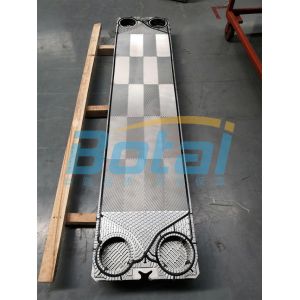
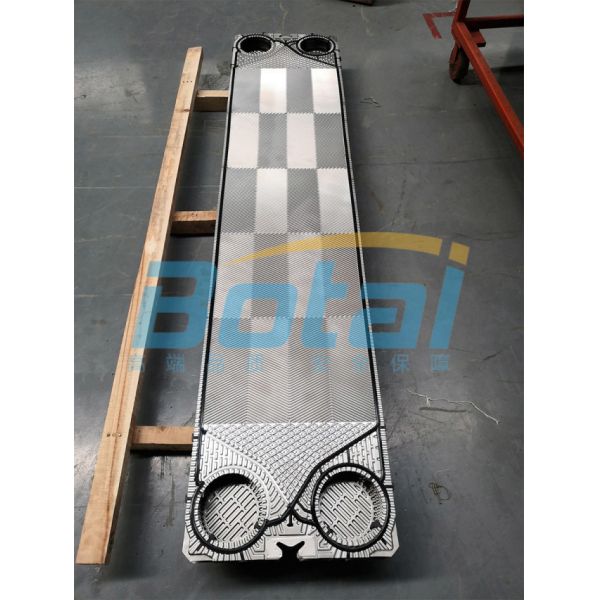
| Metal Sheet | Made of thin metal sheets through mold stamping, with corrugations, sealing grooves and corner holes pressed on the surface | 1. Heat Transfer Enhancement: The corrugated structure expands the
heat transfer contact area, breaks the medium flow boundary layer,
and improves heat transfer efficiency; 2. Structural Reinforcement: The corrugated design increases the rigidity of the thin sheet, directly improving the overall pressure-bearing capacity of the plate heat exchanger; 3. Self-cleaning and Anti-clogging: Corrugations guide the medium to flow in a turbulent state, reducing the accumulation of sediments and dirt on the plate surface and lowering the cleaning frequency; 4. Flow Channel Distribution: Corner holes cooperate with sealing grooves to divide independent flow channels for hot and cold media, ensuring fluid flows according to the designed path |
| Sealing Gasket | Customized to match the plate size, installed in the gasket groove around the plate | 1. Sealing and Leak Prevention: Fills the gaps between plates to
prevent fluid leakage to the outside (refer to "Causes and
Solutions for External Leakage of Plate Heat Exchangers" for more
leakage prevention solutions); 2. Flow Channel Partitioning: Seals some corner holes according to design requirements, forcing hot and cold media to flow in dedicated channels and eliminating the risk of cross-flow |
| Component Type | Core Function | Impact on Gasket Performance |
|---|---|---|
| Rubber Polymer | Base material of the gasket | Determines the basic elasticity, temperature resistance and corrosion resistance of the gasket (e.g., natural rubber, isoprene rubber, etc.) |
| Vulcanizing Agent | Cross-links rubber molecules | Improves the strength, hardness and aging resistance of the gasket, preventing deformation after long-term use |
| Filler | Optimizes physical properties | Reduces costs while enhancing the wear resistance and pressure resistance of the gasket |
| Anti-aging Agent | Delays aging rate | Extends the service life of the gasket and reduces performance degradation caused by oxidation and light |
| Processing Aid | Improves manufacturing process | Does not directly improve usability, but optimizes the processing fluency of mixing, extrusion and molding processes |
| Diluent | Adjusts the viscosity of rubber compound | Facilitates gasket forming and ensures precise size matching with the plate gasket groove |
| Rubber Type | Chemical Composition | Core Performance Advantages | Suitable Scenarios |
|---|---|---|---|
| Natural Rubber | Extracted from Hevea brasiliensis latex, mainly composed of cis-polyisoprene | Excellent elasticity, high mechanical strength, good wear resistance, and good compatibility with other rubbers | Normal temperature, low pressure, neutral medium scenarios (e.g., civil HVAC systems) |
| Isoprene Rubber (Synthetic Natural Rubber) | Polymerized from isoprene, with a structure similar to natural rubber | Performance close to natural rubber, stable raw material supply, and can replace natural rubber | General working conditions requiring stable supply and performance matching natural rubber |
| Styrene-Butadiene Rubber (SBR) | Copolymerized from butadiene and styrene (two types: emulsion polymerization and solution polymerization) | Good aging resistance, better wear resistance than natural rubber, and low cost | General industrial sealing scenarios, suitable for non-strongly corrosive media |
| Polybutadiene Rubber (BR) | Polymerized from butadiene | Excellent cold resistance, wear resistance and elasticity, low heat generation under dynamic load, strong aging resistance, and easy blending with natural rubber and neoprene | Low-temperature environments and high dynamic load working conditions (e.g., low-temperature fluid heat exchange, frequently started/stopped heat exchangers) |
|
 Plate Frame Gasket Heat Exchanger
Gasket Plate Heat Exchanger Parts for Custom Frame Units
Durable Plate Heat Exchanger for Central Heating Applications
Detachable High-Efficiency Industrial Plate Heat Exchanger
Plates and Gaskets for Plate Heat Exchangers
High-Efficiency Plate Cooler for Heat Exchange
Plates in plate heat exchangers isolate media conduct heat exchange
Removable plate heat exchanger with high heat transfer coefficient
Removable plate heat exchanger with high heat transfer coefficient
Semi-welded plate heat exchanger for heating and corrosive medium cooling
Plate Frame Gasket Heat Exchanger
Gasket Plate Heat Exchanger Parts for Custom Frame Units
Durable Plate Heat Exchanger for Central Heating Applications
Detachable High-Efficiency Industrial Plate Heat Exchanger
Plates and Gaskets for Plate Heat Exchangers
High-Efficiency Plate Cooler for Heat Exchange
Plates in plate heat exchangers isolate media conduct heat exchange
Removable plate heat exchanger with high heat transfer coefficient
Removable plate heat exchanger with high heat transfer coefficient
Semi-welded plate heat exchanger for heating and corrosive medium cooling